Skip to content

Vote for someone again.

Too many of us walk into the booth voting against somebody. Score voting lets you rate every candidate from 0 to 10, so you can back the one you believe in without helping the one you fear.

Sample ballot · Score voting

Your next election

Score every candidate from 0 to 10. 0 = worst, 10 = best. Skip anyone you don’t know.

Score for The one you love

The one you love

Score for The one you can live with

The one you can live with

Score for The one you can’t stand

The one you can’t stand

Score for The one you’ve never heard of

The one you’ve never heard of

Go ahead: tap a bubble for each one. Tap it again to clear it.

You walk into a booth. You pick one name. You leave.

The first lines of Score the Vote.

You marked the one you can live with, to stop the one you can’t stand. The ballot never hears about the one you love.

“You didn’t show up with one opinion; you showed up with a dozen.”

Score the Vote, ch. 1

“Your entire political conscience, flattened into a single oval.”

Score the Vote, ch. 1

63%

want a third major party.

About2%

vote for one.

“Sixty-three percent want the option; two percent exercise it. That gap isn’t hypocrisy, and it isn’t apathy. It’s arithmetic.”

Score the Vote, ch. 2

Source: Gallup, Oct 2023 (63% say a third major party is needed); third-party share of the 2020 and 2024 presidential vote.

That system is eleven bubbles wide.

It’s called score voting. You rate every candidate from 0 to 10, the way you already rate a restaurant or a movie.

Every candidate gets a row like this. Give the one you believe in a 10, the one you could live with a 6, and the one you fear a 0, all on the same ballot.

  1. Score every candidate from 0 to 10.

    Ten means “this is who I want.” Zero means “I do not want this person in office.” Give the same score to as many people as you like.

  2. Leave anyone blank.

    Never heard of someone? You don’t have to score them.

  3. Add up the scores. The highest total wins.

    Every ballot counts toward every candidate, all at once, in a single round.

The spoiler effect has no party.

Pick-one voting punishes whichever side runs one candidate too many. It has done it to the right and to the left.

The right split

1912

Denied the Republican nomination, Theodore Roosevelt ran anyway as a third-party candidate and split the vote with William Howard Taft. More than half of all voters chose one of the two. Woodrow Wilson won with 41.8%.

Roosevelt 27.4% + Taft 23.2%

50.6%

Wilson (won)

41.8%

Share of the national popular vote. The dashed line is half.

Source: 1912 presidential popular vote.
The left split

Florida, 2000

George W. Bush’s certified margin over Al Gore was 537 votes, out of nearly six million. On the same ballot, Ralph Nader drew 97,488: 181 times the margin.

Nader’s votes

97,488

Bush’s winning margin

537

That sliver is the 537. Both bars are drawn to the same scale.

Source: Certified Florida results, 2000 (Florida Dept. of State).

“Under plurality, third-party candidates are spoilers. Under score voting, they’re just... candidates.”

Score the Vote, ch. 14

The good candidates are already out there. The ballot keeps them home.

“Change the ballot, and you don’t have to go looking for better leaders. You simply unlock the door and let the ones we already have walk through it.”

Score the Vote, ch. 1

  • Imagine voting for the candidate you believe in, knowing it can’t help the one you fear.
  • Imagine independents and third-party candidates who are just candidates, judged on what they’d do.
  • Imagine winners who had to earn a good score from voters well beyond their base.
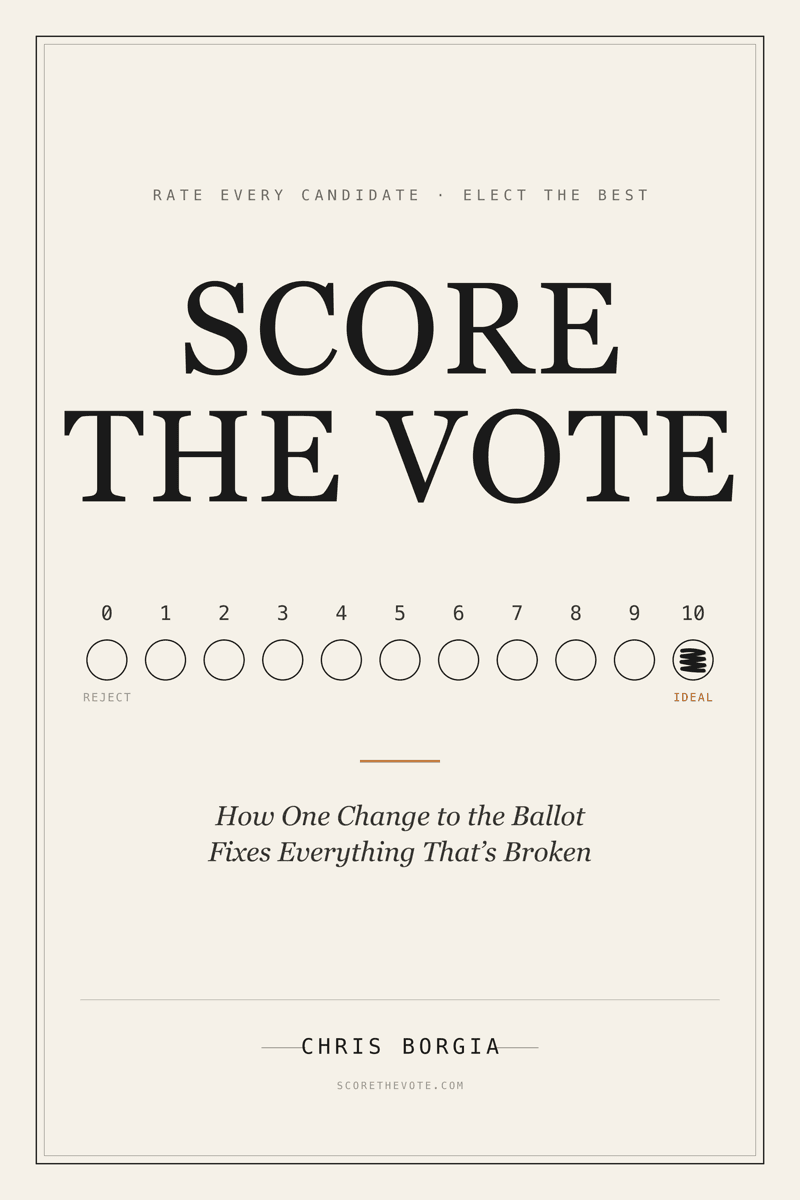
The cover of Score the Vote by Chris Borgia: the title in black capitals above a row of eleven ballot bubbles numbered 0 to 10, with the 10 scribbled in.

90 pages. One idea.

Score the Vote: How One Change to the Ballot Fixes Everything That’s Broken

By Chris Borgia: 19 short chapters you can read in about an hour.

“We were promised self-government. What we got is the lesser of two evils, rebranded every four years as a moral emergency.”

Score the Vote, ch. 1

Fair questions.

Skeptical? Good. These are the ones we hear most.

More questions and objections

Isn’t this just ranked-choice voting?

No. Ranked choice asks you to put candidates in order, then eliminates them one round at a time. Score voting asks how much you support each candidate on their own, and counts everything at once.

Ranked choice is a real improvement over pick-one, and the book gives it a chapter of credit. But in Burlington, Vermont (2009) and Alaska (2022), it eliminated the candidate who beat every rival head-to-head. Scoring everyone in a single count avoids that trap.

Does it help one party?

No, and the record cuts both ways. A spoiler split the right in 1912 and the left in 2000. In Alaska in 2022, ranked choice eliminated Republican Nick Begich even though he beat both finalists head-to-head; in Burlington in 2009, it eliminated Democrat Andy Montroll, who also beat both finalists.

Better counting finds the candidate the most voters can stand behind, whatever their party. As the book puts it: the spoiler effect has no party.

Won’t people just give 10s and 0s?

Some will, and that’s fine. Every voting method can be gamed. Under score voting the “gaming” move is to give only 10s and 0s, which turns your ballot into an approval ballot: still far better than picking one.

What you never have to do is rate your favorite below anyone to protect yourself. Plurality forces that choice on millions of voters every election.

Has it been used in real elections?

Its simplest form has. Approval voting is score voting with only two levels. Voters adopted it in Fargo, North Dakota (2018, 63.5%) and St. Louis, Missouri (2020, 68%). St. Louis still uses it; Fargo used it three times before North Dakota’s legislature banned it in 2025.

Full 0–10 score voting isn’t used in any U.S. government election yet. That’s what this campaign is for.

How does this actually get adopted?

From the ground up. Start where no law stands in the way: clubs, unions, student governments, party conventions, nonprofits. Next come cities with citizen initiatives, which is how Fargo and St. Louis did it.

Be clear-eyed: many states now restrict alternative voting methods, so check your state’s law before you organize. The last three chapters of the book are the playbook.

Democracy is not a spectator sport.

Score the vote.

Score the Vote, ch. 19

Stay in the fight.

Get updates from the campaign by email.